The U.S. Court of Appeals for the 9th Circuit has effectively dismantled a legal pathway that would allow Donald Trump—or any future president—to federalize and deploy state National Guard troops inside the United States without a governor's consent. By tightening the judicial standards governing emergency domestic deployments and reinforcing the statutory boundaries of the Posse Comitatus Act and Title 10 of the U.S. Code, the appellate panel closed a decades-old constitutional gray area. Governors retain primary command over their state militias unless specific, strictly defined insurrectionist thresholds are met.
Most coverage treats this ruling as another routine skirmish in the endless legal trench warfare between blue-state attorneys general and the White House. That misses the actual story. Beneath the partisan headlines sits a structural collision over who controls armed force on American soil when Washington and a state capital stop agreeing on what constitutes an emergency.
The Architecture of Dual Sovereignty
To understand why the 9th Circuit's decision carries teeth, you have to look at the weird, hybrid DNA of the National Guard. Unlike the active-duty Army or Marines, the National Guard answers to two masters.
Under Title 32 of the U.S. Code, Guard units operate under the command and control of their respective state governors, even when the federal government foots the bill. When a hurricane flattens a coastline or a wildfire jumps a containment line, the governor calls the shots. In this posture, Guard troops are also exempt from the Posse Comitatus Act, the 1878 federal law that bars the U.S. military from acting as a domestic police force.
Everything flips the moment a president invokes Title 10.
Federalizing the Guard strips the governor of command, places the troops directly into the federal chain of command under the Pentagon, and converts citizen-soldiers into active-duty federal personnel. Once that switch flips, the Posse Comitatus Act snaps shut like a steel trap—unless the president simultaneously invokes the Insurrection Act of 1807.
For years, executive branch lawyers operated under the assumption that a president's determination of an emergency was essentially unreviewable by federal courts. The theory was simple. If the White House claimed federal laws could not be enforced by normal judicial proceedings, judges were supposed to defer to the Commander in Chief and step aside.
The 9th Circuit just rejected that blank check.
Where Executive Overreach Hit a Wall
The legal friction did not materialize out of thin air. During the civil unrest of 2020, and throughout subsequent policy battles over border enforcement and urban crime, advisors inside the Trump orbit repeatedly floated the idea of unilateral Guard deployments. The blueprint relied on an expansive reading of 10 U.S.C. § 12406, an obscure statutory provision that allows a president to call the Guard into federal service if the country is invaded, if there is a rebellion against the authority of the U.S. government, or if the president is unable with regular forces to execute federal laws.
Look closely at that third trigger. Unable with regular forces to execute federal laws.
That single clause became the master key for executive branch maximalists. In internal memos and public campaign speeches, allies argued that if a governor refused to cooperate with federal immigration sweeps, or if local police struggled to contain street protests around a federal courthouse, the president could unilaterally federalize that state's own Guard units to do the job. Worse, the administration could theoretically federalize Guard troops from a compliant state—say, Texas or Florida—and march them into California or Oregon over the explicit objections of the local governor.
The 9th Circuit's ruling attacks the foundational premise of that strategy. Rather than treating presidential declarations under Title 10 as magic words that automatically strip courts of jurisdiction, the appellate judges insisted on justiciability. In plain English, the White House cannot simply declare an emergency on paper to bypass state sovereignty; the factual predicate has to actually exist on the ground.
If local courts are open, if federal agencies are functioning, and if state authorities have not actively collapsed into armed rebellion, the statutory trigger for a unilateral federal takeover fails.
The Ghosts of Little Rock and Los Angeles
History complicates the easy partisan narratives surrounding this fight. Unilateral federalization of the National Guard is not a modern invention, nor has it always been wielded by one political faction.
In 1957, President Dwight D. Eisenhower federalized the entire Arkansas National Guard—10,000 soldiers—to strip them away from Governor Orval Faubus, who was using those very troops to block nine Black students from integrating Central High School in Little Rock. Six years later, John F. Kennedy used the exact same mechanism against George Wallace in Alabama. In those moments, federalizing the Guard against a governor's will was the only mechanism capable of enforcing constitutional rights against state-sanctioned defiance.
Then came 1992. When Los Angeles erupted following the Rodney King verdict, President George H.W. Bush federalized the California National Guard under the Insurrection Act—but he did so at the urgent request of California Governor Pete Wilson.
Compare those historical baselines to the modern legal clash. In Little Rock, a state governor was actively using state military assets to defy a direct order of the U.S. Supreme Court. In the modern disputes reaching the 9th Circuit, federal officials sought to federalize state forces not because state governments were in open rebellion, but because state officials disagreed with federal policy priorities or declined to dedicate local police resources to federal civil enforcement.
The Statutory Friction Points
| Legal Mechanism | Primary Authority | Governor Consent Required | Domestic Policing Allowed | Judicial Review Standard |
|---|---|---|---|---|
| State Active Duty | State Constitution / Law | Yes (Initiated by Governor) | Yes | State Courts |
| Title 32 Status | 32 U.S.C. § 502(f) | Yes (Federal funding, state command) | Yes | Minimal federal intervention |
| Standard Title 10 | 10 U.S.C. § 12406 | Historically contested; now heavily restricted | No (Barred by Posse Comitatus) | Subject to factual verification under 9th Circuit standard |
| Insurrection Act | 10 U.S.C. §§ 251–255 | No (Under specific statutory triggers) | Yes (Explicit statutory exception) | Historically deferential, though boundaries are narrowing |
What the Critics Miss About the Ruling
Legal analysts cheering the 9th Circuit's decision as a permanent firewall against authoritarianism are celebrating too early. Those attacking it as a crippling blow to national security are exaggerating its reach. Both sides are ignoring the glaring loopholes left intact by the court's narrow statutory focus.
First, the ruling hinges heavily on how federal courts interpret administrative and statutory limits under Title 10, rather than striking down the underlying statutes as unconstitutional. That leaves the Insurrection Act of 1807 sitting untouched in the statutory code like an unexploded artillery shell. Because the Insurrection Act grants the president explicit, sweeping authority to suppress domestic violence or conspiracies that hinder the execution of federal law, a future administration determined to bypass a governor would simply skip the routine Title 10 mechanisms and go straight for the nuclear option.
Second, the 9th Circuit only controls federal district courts within its geographic footprint—California, Oregon, Washington, Arizona, Nevada, Idaho, Montana, Alaska, and Hawaii. A circuit split is practically guaranteed. If a similar dispute erupts in Texas, Illinois, or New York, the 5th, 7th, or 2nd Circuits could easily adopt a far more deferential posture toward presidential power, forcing the U.S. Supreme Court to settle the constitutional boundary once and for all.
And the current Supreme Court has shown a marked appetite for expanding unitary executive authority while viewing state-level obstruction of federal immigration and security policies with deep skepticism.
The Operational Nightmare Nobody Talks About
Step out of the courtroom for a second and look at what actually happens on the ground when Washington and a statehouse go to war over the Guard. Lawyers love clean doctrinal lines. Brigade commanders deal in logistics, fuel, communications, and chain-of-command chaos.
Consider a hypothetical scenario where a president orders the federalization of 2,000 National Guard troops in a western state over the governor's explicit refusal, and the governor orders the state's Adjutant General—the senior military officer appointed by the governor—to stand down.
Who does the battalion commander obey?
In the American military tradition, every officer swears an oath to the Constitution, and under the Supremacy Clause, lawful federal orders supersede state directives. Yet Guard officers rely on the state governor for promotions, state funding, and command assignments. Forcing a citizen-soldier who works as a civil engineer on Tuesday to choose between a court-martial from the Pentagon and termination by their governor on Wednesday is a recipe for institutional fracture.
Worse, federalizing the Guard without state cooperation cripples the very logistical network that makes domestic deployments work. State emergency management agencies, local police radio frequencies, municipal water and power grids, and county staging areas are controlled by state and local officials. A federalized Guard unit dropped into a hostile political environment without state buy-in operates blind, stripped of local intelligence and forced to rely on clunky federal supply chains designed for overseas combat theaters rather than suburban intersections.
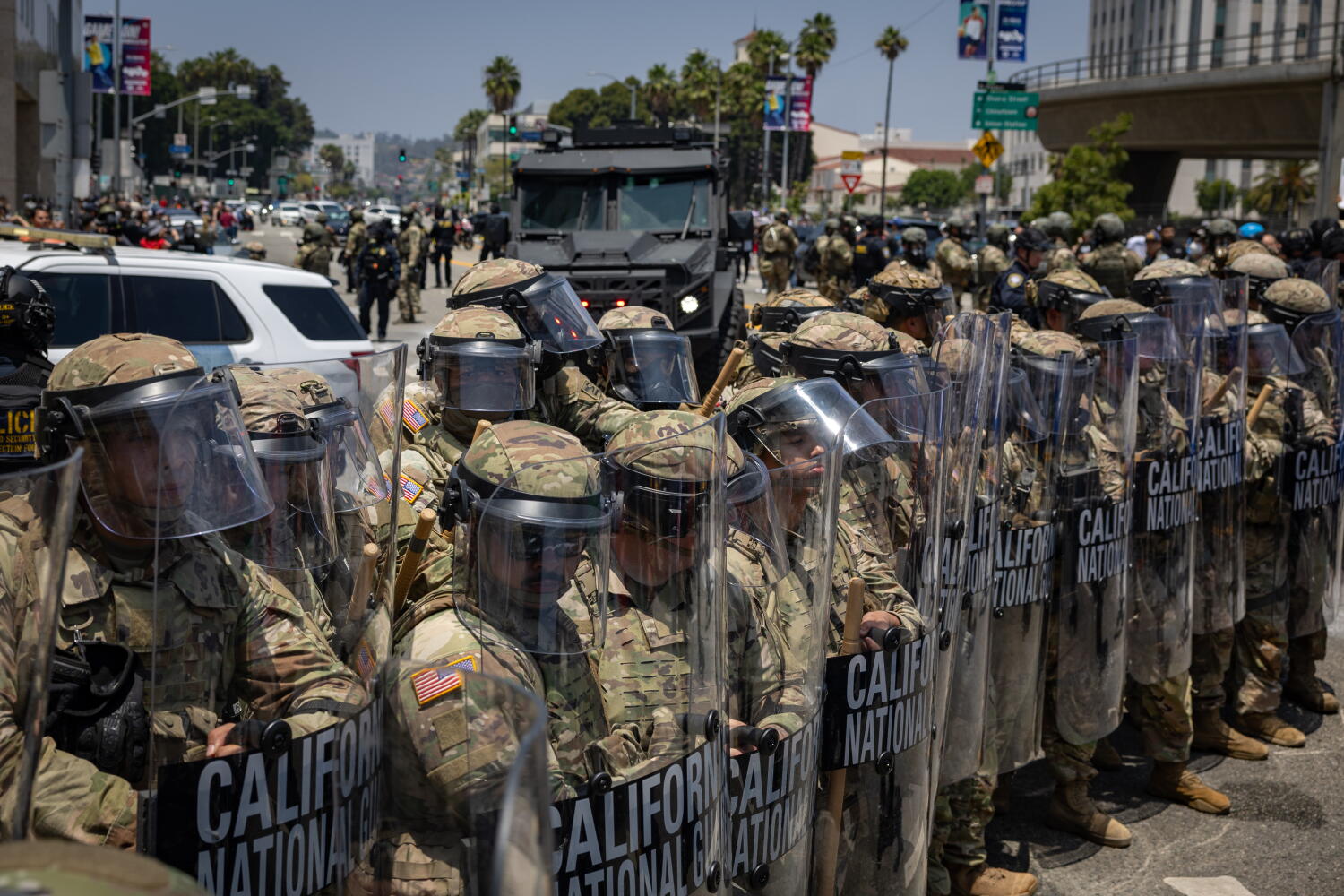
The Pentagon knows this. Senior military leaders at the National Guard Bureau have quietly spent years trying to avoid being dragged into domestic political crossfire, recognizing that nothing destroys public trust in the armed forces faster than deploying camouflage uniforms into American cities against the wishes of local elected leaders.
The Real Shift in Constitutional Power
Strip away the immediate political personalities, and the 9th Circuit's opinion marks a rare judicial check on a century-long drift toward centralized executive power. Since World War II, Congress has steadily handed presidents an arsenal of emergency authorities, operating on the gentleman's agreement that commanders-in-chief would exercise restraint.
That gentleman's agreement is dead.
By ruling that the executive branch cannot manufacture an emergency to commandeer state militias, the appellate court reasserted a core principle of American federalism: the states are not mere administrative subdivisions of Washington, and their militias are not a private reserve force for the Oval Office. The ruling forces any president contemplating domestic military intervention to clear a high, verifiable evidentiary bar—and submit those claims to the scrutiny of federal judges before the first Humvee rolls out of the armory.
Until the Supreme Court steps in to redraw the map, the message to the West Wing is unambiguous: you cannot take a governor's troops without proving the state has actually fallen.