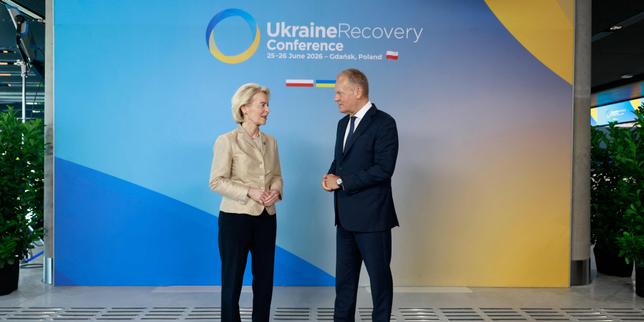
The money is finally moving. Kyiv just received the first 3.2 billion euros from the European Union's massive 90 billion euro loan package. European Commission President Ursula von der Leyen made the official announcement on Thursday at the Ukraine Recovery Conference in Gdansk, Poland. It ends months of agonizing political gridlock in Europe. It also provides a critical lifeline to a country fighting a war of attrition.
Many onlookers view these international financial packages as mere bureaucratic paperwork. That is a mistake. This money keeps the Ukrainian state from collapsing under the weight of its massive defense spending. It is the backbone of their domestic survival.
The First Tranche Hits Kyiv Accounts
The 3.2 billion euros transferred this Thursday represents the opening act of a broader macro-financial assistance program. The European Union designed this package to span across 2026 and 2027. The plan splits the money evenly, allocating 45 billion euros for this year and another 45 billion euros for next year.
This initial cash injection serves a very specific purpose. It provides direct budget support. When a country spends almost its entire domestic tax revenue on weapons, ammunition, and soldiers' salaries, it struggles to pay for everything else. This money will fund schools, keep hospitals open, and pay pensions for millions of citizens. It acts as an economic shield while the military fights on the front lines.
The timing of the release matters immensely. European officials promised this money months ago, but political infighting slowed things down. Getting the cash to Kyiv before the end of the second quarter of 2026 was a major milestone for the European Commission. They just barely made the deadline.
Behind the Months of Political Gridlock
The road to this cash transfer was incredibly messy. The European Council originally agreed on the 90 billion euro loan package back in December 2025. It was a historic compromise. European leaders couldn't agree on seizing frozen Russian central bank assets, so they created this loan structure instead. The repayment terms are unique. Ukraine only has to pay the money back once Russia pays war reparations.
Then came the obstruction. Hungarian Prime Minister Viktor Orban used his veto power to freeze the entire process. He accused Ukraine of sabotaging the Druzhba oil pipeline, which carries Russian crude through Ukrainian territory into Hungary and Slovakia. For months, Brussels watched in frustration as one single member state paralyzed the financial strategy of the entire bloc. The veto did not just stop the loan. It also blocked a milestone twentieth package of sanctions against Moscow.
Everything shifted in April 2026. Orban suffered a massive defeat in the Hungarian legislative elections. His sixteen-year grip on power ended. His successor, the pro-European Peter Magyar, immediately reversed course. The pipeline dispute resolved, the veto dissolved, and the path cleared. The relief in Brussels was palpable. European leaders avoided a total financial disaster by a matter of weeks.
The Actual Mechanics of the 90 Billion Package
Understanding how this loan works requires looking past the big, shiny numbers. The EU isn't just handing over a blank check for 90 billion euros. The funding has strict divisions and conditions.
For 2026, the macro-financial assistance part of the loan totals 8.35 billion euros. This Thursday's 3.2 billion euro transfer is the first of three planned payments for the year. If everything goes according to plan, a second payment of roughly 3.7 billion euros will land in September. The final chunk of about 1.45 billion euros should arrive before December.
Separately, there is a distinct 6 billion euro package dedicated to defense procurement, specifically drone production. Ukraine has established itself as a global leader in drone warfare. They build them cheaply and effectively. The EU initially planned to bundle drone funding into this week's transfer, but officials decoupled it at the last minute to speed up the budget support. Von der Leyen confirmed that the first defense funds for drones will roll out in the coming days.
This separation allows the immediate budget aid to flow without waiting for the complex military procurement contracts to clear. It keeps the wheels of government turning.
Why This Cash Inject Matters Right Now
Vladimir Putin’s strategy relies on outlasting the West. He wants to grind Ukraine down economically and wait for international support to dry up. He expects European voters to grow tired of the financial burden. He bets on political paralysis in Washington and Brussels.
This 90 billion euro package damages that strategy. It provides Ukraine with two full years of financial predictability. Kyiv can plan its national budget through 2027 without wondering if the government will run out of money next month. That level of certainty changes how a nation fights a war.
It also signals a shift in European responsibility. With political debates in the United States creating uncertainty around long-term American aid, Europe is stepping up to shoulder more of the burden. Total European economic, financial, and military support since the 2022 invasion now tops 200 billion euros. The continent is realizing that Ukrainian security directly links to its own stability.
The Stiff Conditions Attached to the Money
The European Union expects a lot in return for this cash. The money links to a Memorandum of Understanding signed between Brussels and Kyiv in May 2026. This document contains a long list of domestic reforms.
Ukraine must improve its public financial management systems. It needs to fight corruption, increase domestic tax revenues, and make public spending more transparent. European auditors will track where these billions go. If Kyiv fails to meet these reform benchmarks, the EU can pause the upcoming September and December payments.
This arrangement forces Ukraine to modernize its state institutions even during a brutal war. It helps prepare the country for its eventual goal of joining the European Union. Accession negotiations opened earlier this year, and meeting these loan conditions directly aligns with the requirements for EU membership.
The immediate next steps are clear. The Ukrainian central bank must process this 3.2 billion euro influx to stabilize the national currency and fund public sector obligations. Meanwhile, government officials in Kyiv must keep pushing the required anti-corruption reforms through parliament to ensure the September tranche arrives on time. There is no room for delay.