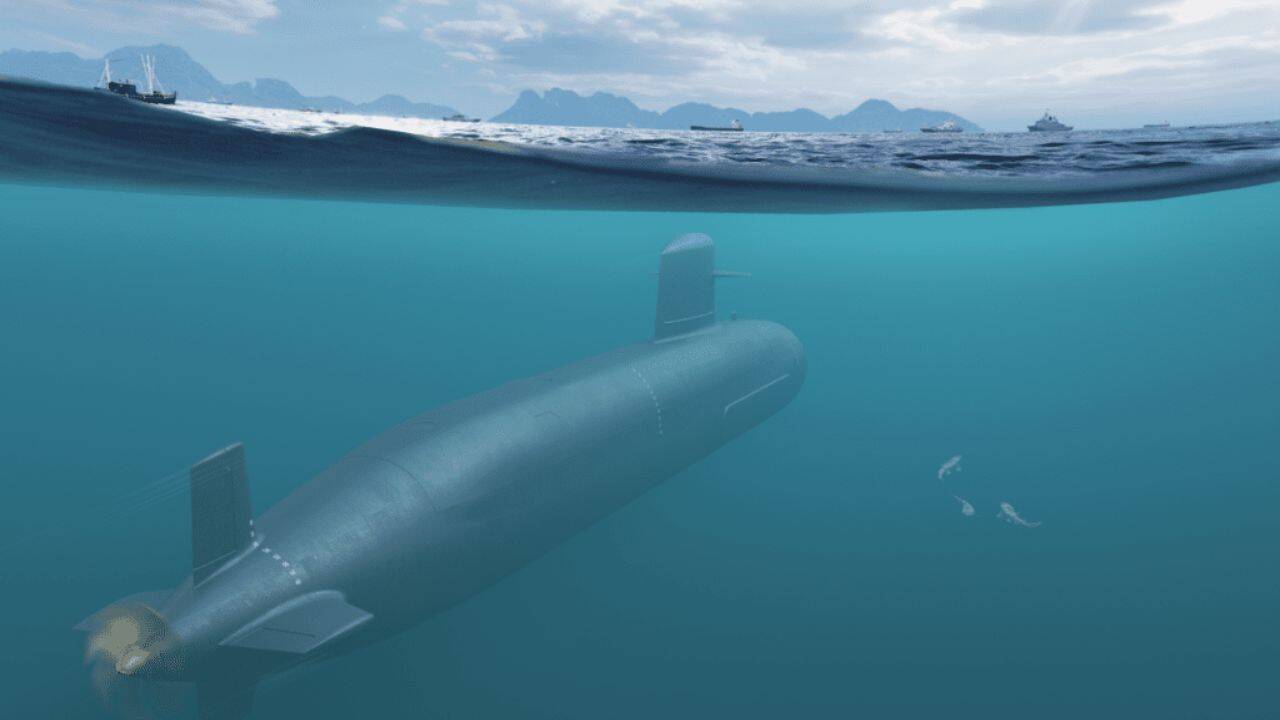
Naval analysts are swooning over Indonesia’s deal with France’s Naval Group for two Scorpène Evolved submarines. The defense press is running identical headlines trumpeting a single, seductive metric: 80 days of un-refueled endurance. They call it a revolution for Jakarta’s maritime strategy. They claim it fundamentally alters the balance of power in the Indo-Pacific.
They are wrong. They are falling for a classic defense contractor spreadsheet victory. Don't forget to check out our earlier article on this related article.
The defense procurement world loves numbers that look good on a sales brochure. Eighty days at sea sounds magnificent. It sounds like strategic denial on a budget. But out in the deep water, away from PowerPoint presentations, that 80-day figure is a theoretical maximum calculated under laboratory conditions. It assumes a compliant ocean, zero tactical complications, and a crew made of emotionless robots.
When you strip away the marketing gloss, Indonesia’s new underwater assets reveal a deeper problem in how modern navies buy technology. Jakarta did not buy an un-trackable phantom capable of policing the archipelago for three months straight. They bought a highly sophisticated, incredibly expensive engineering compromise that pushes the physical limits of conventional hulls while ignoring the actual bottlenecks of modern naval warfare. To read more about the background of this, The New York Times provides an excellent summary.
The Meatware Bottleneck: Humans Do Not Scale Like Lithium-Ion
Naval Group’s big pitch for the Scorpène Evolved is the transition from traditional lead-acid batteries to a full Lithium-ion (Li-ion) configuration. This configuration configuration supposedly expands the boat’s energy storage capacity exponentially. It allows the submarine to maintain high submerged speeds for longer periods and dramatically cuts down the time the boat needs to spend snorkeling to run its diesel generators.
But batteries only power systems. They do not power the crew.
I have spent years analyzing naval deployments and looking at the physiological data of crews confined to tight steel tubes. The human factor—the "meatware"—is always the first point of failure. On a conventional diesel-electric hull measuring around 72 meters, space is at an absolute premium.
Consider the realities of an extended deployment:
- Fresh Food Limits: You can pack dry rations for months, but fresh food rots within two to three weeks. After day 20, morale drops as the diet shifts to canned mush.
- Psychological Decay: Nuclear submarines can stay submerged for months because they are massive. They have water-making plants that don't drain propulsion energy, larger berths, and better air filtration systems. A Scorpène-sized hull offers no such luxury. Confine 30 to 40 sailors in those tight quarters for 50 days, and watch reaction times slow and decision-making degrade.
- Waste Management: Eighty days of human waste, trash, and greywater requires storage or discharge. Discharging waste creates acoustic signatures and thermal tracks. Storing it kills internal space.
When a defense journalist writes that a conventional submarine can stay at sea for 80 days, they mean the hull can survive it. The crew cannot operate at peak combat readiness for that long. A tired crew makes noise. A tired crew misses a sonar contact. A tired crew mismanages a ballast tank. In a real conflict, an 80-day patrol turns a high-tech asset into a floating underwater asylum by week six.
The Theoretical Physics vs. Tactical Realities
Let's talk about how Naval Group generated that 80-day figure. To get maximum endurance out of any conventional submarine, you have to run it at what submariners call "economy speed." This usually means creeping along at 3 to 4 knots.
Imagine a scenario where Indonesia deploys a Scorpène Evolved from its base in Natuna to patrol the Lombok Strait. At 4 knots, just getting to the station consumes a massive chunk of that 80-day window.
More importantly, the Indo-Pacific is not an empty swimming pool. It is a hyper-monitored, acoustically chaotic environment packed with anti-submarine warfare (ASW) assets. If the Scorpène encounters a hostile surface action group or an enemy nuclear attack submarine, it cannot just creep along at 3 knots. It has to evade. It has to sprint.
The moment a Lithium-ion submarine throttles up to its top speed of 20+ knots, the laws of thermodynamics take over. High-speed runs drain Li-ion batteries at a terrifying rate.
[Low Speed: 3-4 Knots]  --> Extends battery life toward theoretical limits.
[High Speed: 20+ Knots] --> Massive energy draw; drains reserves in hours, not days.
If a Scorpène is forced to sprint for even a few hours to escape a dragging sonar array, its 80-day endurance projection evaporates. The captain is then forced to make a choice: abort the mission and head home early, or risk snorkeling in a contested zone where enemy maritime patrol aircraft are hunting for mast signatures.
The Indo-Pacific Choke Point Fallacy
The strategic consensus claims that Indonesia needs long-endurance submarines to guard its primary maritime choke points: the Malacca, Sunda, and Lombok straits. The narrative suggests that these boats will sit in these narrow channels, creating an impenetrable wall against foreign navies.
This ignores basic geography and hydrography.
The Malacca Strait is shallow, crowded, and plagued by shifting sandbanks and heavy commercial traffic. Operating a 2,000-ton submarine in waters that average less than 30 meters deep is operational madness. The Sunda Strait is highly volatile, seismically active, and acoustically noisy.
The Lombok Strait is deeper and more viable for underwater operations, but it is also a well-known choke point that every major blue-water navy maps constantly. If an adversary knows you have exactly two high-endurance submarines, they do not need to hunt them across the vast expanse of the Indian Ocean. They simply need to seed the entry and exit vectors of the Lombok Strait with underwater acoustic arrays and unmanned underwater vehicles (UUVs).
By focusing so heavily on the endurance of a single platform, Indonesia is investing in a highly centralized asset that is vulnerable to asymmetric denial. Instead of a multi-layered net of cheaper, smaller coastal submarines and autonomous sensors, Jakarta is putting its chips on two expensive targets that must travel long distances from centralized maintenance facilities to reach their operational areas.
Dismantling the Lithium-Ion Safety Narrative
We must also confront the elephant in the engine room: the stability of Lithium-ion technology in naval applications.
Naval Group points to Japan’s Taigei-class submarines as proof that Li-ion is ready for prime time. The Japanese Maritime Self-Defense Force is arguably the finest conventional submarine force in the world, and they have embraced Li-ion. But Japan has a domestic industrial infrastructure capable of manufacturing, testing, and maintaining these highly volatile battery matrices under pristine conditions.
Indonesia does not. The contract stipulates that these submarines will be built locally by PT PAL in Surabaya. While technology transfer is great for national pride, building a complex Li-ion submarine hull requires manufacturing tolerances that are incredibly difficult to master.
Lithium-ion batteries carry a risk of thermal runaway. If a cell punctures, overheats, or suffers a manufacturing defect, it can trigger a self-sustaining fire that produces toxic gases and temperatures exceeding 900 degrees Celsius. In a sealed submarine hull, a battery fire is an instant death sentence for the crew.
Japan manages this risk with hyper-engineered safety systems, extensive cooling jackets, and redundant monitoring software. Can PT PAL replicate those exact standards on their first try? If they fail, that 80-day endurance capability becomes an 80-day liability.
The Wrong Tool for the Wrong Strategy
What should Indonesia be doing instead? They are asking the wrong question. They asked, "How do we get the longest possible endurance out of a conventional submarine?"
They should have asked, "How do we deny access to our waters at the lowest cost per square mile?"
If you want to stop a hostile navy from transiting your straits, you do not build a couple of multi-hundred-million-dollar French masterpieces that take five years to construct and require immense logistical tails. You deploy distributed lethality.
- Massed UUV Swarms: Instead of one crewed submarine costing a fortune, deploy fifty autonomous underwater gliders. They have no human crew to feed, no psychological breaking points, and can monitor choke points indefinitely for a fraction of the price.
- Coastal Submarines: Smaller, 500-ton midget submarines designed for 10-day deployments are vastly more effective in the shallow waters of the Malacca and Sunda straits. They are cheaper to build, easier to hide, and don't require advanced Li-ion matrices to stay hidden.
- Smart Mines and Mobile Batteries: Pair shore-based anti-ship missile batteries with smart, selective sea mines that can be activated remotely during a crisis.
Indonesia's acquisition strategy is driven by prestige, not practical naval doctrine. They wanted the shiny new toy that matches the specifications of regional rivals. But in doing so, they have committed to a platform that will spend more time in port undergoing complex battery maintenance and crew rehabilitation than actually policing the gaps in the archipelago.
The Scorpène Evolved is an impressive piece of engineering. But don't believe the hype. Eighty days at sea is a fantasy that crumbles the moment the first real torpedo tube opens or the first sailor cracks under the pressure of isolation. Modern naval warfare is brutal, fast, and driven by resource depletion. Buying a sub based on its brochure endurance is like buying a supercar based on its top speed when you live in a city full of speed bumps and traffic jams. It looks great in the garage, but it won't win the race.



