If you think the Bastille Day parade is just about tanks rolling down the cobblestones and jets painting the sky in tricolor smoke, you're missing the real story.
This year, the annual event on the Avenue des Champs-Élysées returned with its usual jaw-dropping scale. We saw 6,686 service members marching in perfect unison, 90 aircraft roaring overhead, and nearly 200 horses from the Republican Guard clattering down the avenue. But beneath the superficial layer of military brass and crisp uniforms, the 2026 edition carried a completely different weight.
Two massive shifts altered the vibe of this year’s national holiday. First, the French Ministry of the Armed Forces framed the entire event around a blunt theme: "Europe's Strategic Wake-Up Call". Second, a major scheduling shake-up completely decoupled the morning's military display from the city's famous nighttime partying.
If you didn't know what to look for, it just looked like a great show. Here is what was actually happening on the ground.
The Geopolitical Shift on the Champs-Élysées
For the last few years, European military events have felt less like historical traditions and more like active situational responses. This year's Bastille Day parade made that subtext entirely explicit.
By centering the procession on Europe's strategic readiness, France used its national day to send a direct message to the rest of the continent. This wasn't just French pride. It was a demonstration of coalition strength. Delegations from NATO and the European Union marched right alongside French troops, accompanied by representatives from 35 countries involved in the Coalition of Volunteers.
The visual highlights included:
- The Foreign Contingent: Ukrainian forces were given a prominent spot in the marching columns, drawing massive applause from the crowds packed behind the security barriers.
- The Naval Milestone: The grand finale of the parade paid tribute to 400 years of the French Navy, which was founded back in 1626. The soundtrack for the final performance ditched standard military marches for music heavily influenced by the coastal culture of Brittany.
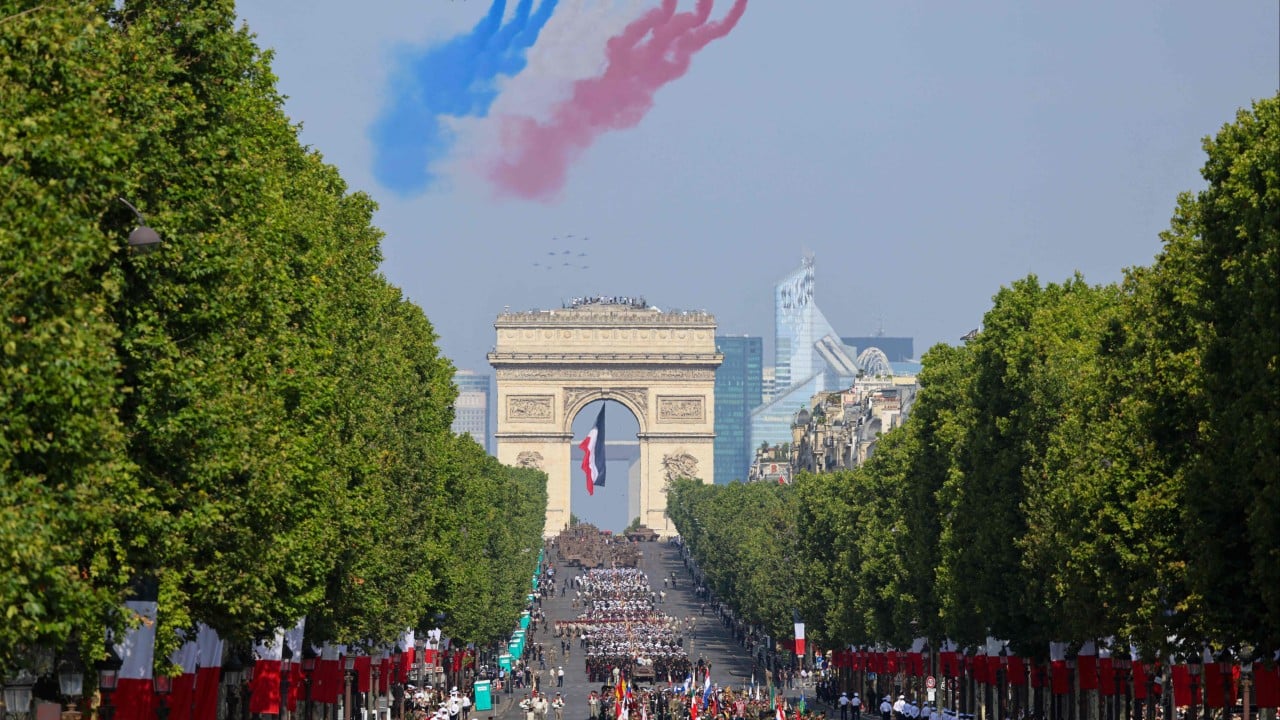
President Emmanuel Macron presided over the ceremony, starting with the traditional review of the troops at the Arc de Triomphe before moving down the 2-kilometer route toward Place de la Concorde. The precision was almost robotic. The flypast by the Patrouille de France aerobatic team hit the sky exactly at 10:21 AM, instantly blanketed by thick plumes of red, white, and blue smoke.
Why the Fireworks Happened Early
If you traveled to Paris expecting the traditional July 14th evening fireworks over the Eiffel Tower, you probably got caught off guard.
The city made a radical change for 2026. Because July 14, 2026, marked the exact 10-year anniversary of the horrific terrorist truck attack in Nice, officials decided to split the holiday's timeline. To keep the actual national day focused on solemn remembrance and official commemorations, the high-energy celebrations were moved forward.
The massive Eiffel Tower fireworks show, the open-air concert on the Champ de Mars, and the legendary Bals des Pompiers (Firemen’s Balls) at local fire stations all took place on the night of Monday, July 13.
It turned out to be a massive logistical win. Splitting the events meant the city didn't suffer from its usual 24-hour total gridlock. July 13 was the night of pure summer spectacle—featuring 1,600 synchronized drones and a soundtrack that bounced from Debussy to Queen. July 14 was reserved strictly for the morning parade and quiet, respectful reflection.
What It Takes to Actually See the Parade
Let’s be honest: attending the Bastille Day parade in person is an exhausting test of endurance. Most travel guides gloss over the physical reality of standing on the Champs-Élysées in mid-July.
Security is extraordinarily tight. The Préfecture de Police shuts down the entire perimeter hours before the President even wakes up. If you want a spot where you can actually see the soldiers' faces and not just the back of someone's head, you have to play by a strict set of rules.
- Arrive by 7:00 AM: Seriously. The barriers go up early, and the prime spots near the Arc de Triomphe or the lower sections of the avenue fill up before the sun is fully hot. If you show up at 9:00 AM, you will be stuck behind ten rows of people staring at a screen or a brick wall.
- Pack Like a Backpacker: July in Paris is notoriously hot. You will be standing on concrete for four to five hours with zero shade. Bring plenty of water, sunscreen, and snacks. Don't rely on local cafes; most inside the security zone are either closed or completely inaccessible once the crowd locks in.
- Navigate the Metro Closures: You cannot just ride Metro Line 1 straight to the avenue on the morning of July 14. Stations like Charles de Gaulle–Étoile, George V, Franklin D. Roosevelt, and Concorde are shut down from the start of service until at least 2:00 PM. Your best bet is to take alternative lines to peripheral stations like Monceau or Saint-Philippe-du-Roule and walk into the checkpoint zones.
If standing in a crowd for five hours sounds miserable, skip the street entirely. Head over to the Tuileries Garden or the open areas around Place de la Concorde just before 10:20 AM. You won't see the infantry units, but you'll get an unobstructed, breathtaking view of the heavy transport planes, Rafale fighters, and helicopters screaming low over the city center.