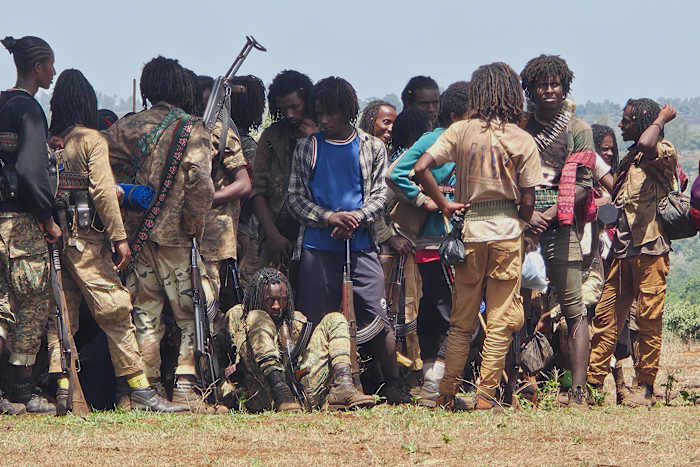
The fragile peace that held northern Ethiopia together for nearly four years is officially broken. When the Tigray People's Liberation Front and Prime Minister Abiy Ahmed’s government signed the Pretoria Agreement in November 2022, diplomats breathed a massive sigh of relief. That devastating civil war had cost hundreds of thousands of lives and devastated an entire region. But peace deals built on political expedience rarely last when the underlying structural wounds are left wide open.
Today, renewed fighting has completely shattered that historic accord. Airports have been seized, supply lines are shifting, and the specter of a wider regional conflagration is back on the table. If you want to understand why northern Ethiopia slid back into chaos, you have to look past the official press releases and examine the raw power struggles happening on the ground. You might also find this related coverage interesting: Why the French-Built Spy Drone on the Poland-Belarus Border Changes Everything.
How the Pretoria Agreement Unraveled From Within
The core issue with the 2022 deal was always about control. Following the cessation of hostilities, a federal interim administration was installed in Mekelle, Tigray's capital, meant to act as a bridge under the watchful eye of Addis Ababa. But the TPLF never truly relinquished its ambition to run the region on its own terms.
Tensions boiled over when internal political maneuvers forced out federal-leaning administrators, allowing veteran TPLF figures like Debretsion Gebremichael to reclaim leadership. Addis Ababa viewed these moves as a direct challenge to constitutional authority. When TPLF fighters seized the airport in Mekelle from federal police custody, any illusion of cooperation vanished. The federal government responded with military force, sparking a rapid escalation that caught international observers flat-footed. As highlighted in latest reports by Associated Press, the results are notable.
A Dangerous New Matrix of Regional Alliances
The battlefield dynamics today bear little resemblance to the 2020-2022 conflict. Back then, Prime Minister Abiy fought alongside Eritrean troops against the TPLF. That dynamic has completely inverted.
Now, regional alliances have shifted in alarming directions:
- Eritrean Backing: Asmara has grown deeply hostile toward Abiy Ahmed, largely driven by disputes over sovereign access to Red Sea ports like Assab. Eritrea has pivoted to supporting the TPLF, providing crucial supply lines and logistics.
- The Fano Factor: Amhara militias known as Fano, who previously fought alongside federal forces against Tigray, are now locked in their own violent rebellion against Addis Ababa. Bizarrely, some factions have found common cause with their former Tigrayan enemies under umbrella coalitions like the newly formed "Alliance for Survival".
- External Spoilers: Other regional actors, including Egypt, have capitalized on Ethiopia's internal vulnerabilities—largely fueled by ongoing disputes over the Grand Ethiopian Renaissance Dam—further complicating the security landscape.
This isn't just a bilateral spat anymore. It is a multi-front crisis threatening the stability of the entire Horn of Africa.
The Humanitarian Toll and Economic Fallout
Wars are fought with weapons, but they are paid for with human lives and economic stability. The renewed violence has already triggered fresh displacement crises in Amhara and Tigray, interrupting vital agricultural cycles and straining humanitarian relief mechanisms that were already overwhelmed by concurrent crises in Sudan.
Commercial flights to Mekelle have ground to a halt, banking services are disrupted, and reconstruction efforts funded by international donors have stalled. Ordinary citizens who spent two years trying to rebuild homes, businesses, and families find themselves caught right back in the crossfire.
Where the Conflict Goes From Here
Military offensives by the Ethiopian National Defense Force have managed to retake key urban centers like Mekelle in recent counter-operations, but holding territory is vastly different from winning a lasting peace. Crushing an insurgency by force while alienating regional populations only sows the seeds for the next uprising.
International pressure from the United Nations and the United States continues to mount, but diplomatic appeals ring hollow when both sides view each other's existence as an existential threat. Unless Addis Ababa addresses the deep-seated grievances tied to ethnic federalism, territorial boundaries like western Tigray, and regional autonomy, northern Ethiopia will remain locked in a perpetual cycle of fragile truces and violent resurgences.