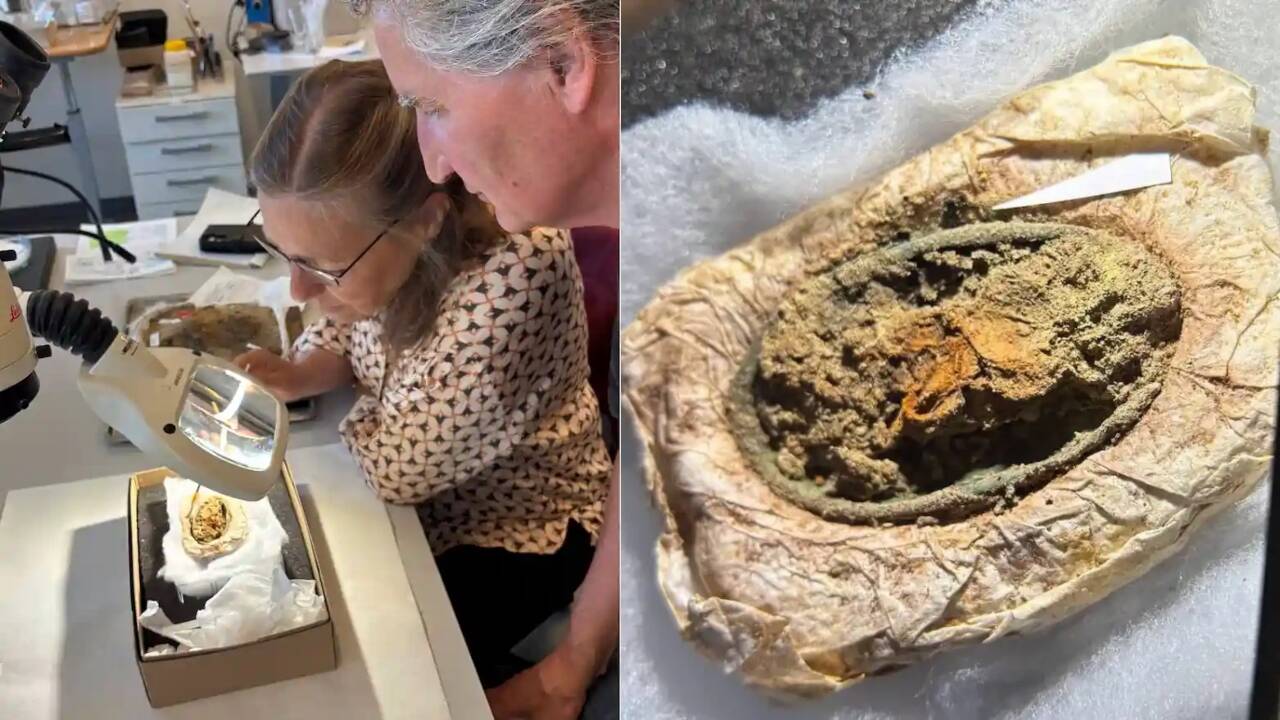
Every time a scrap of wool or linen survives a millennium in a Scandinavian bog or mound, amateur historians lose their minds over ancient ingenuity. The mainstream narrative always bends the knee to the same tired trope. We get endless hagiographies about master Norse weavers, magical fiber preservation techniques, and a lost golden age of sustainable domestic production.
It is absolute nonsense. Expanding on this theme, you can find more in: Medieval Guernsey Manuscript Fragments Structural Analysis of Literary Circulation.
I have spent two decades digging through archaeological reports, standing in climate-controlled museum vaults, and watching modern experimental archaeologists romanticize what was essentially subsistence-level survival. The survival of fragile organic material inside a Danish grave from the eighth or ninth century has nothing to do with superior craft. It has everything to do with a hyper-specific, brutal collision of metallic corrosion, mineral saturation, and chemical isolation.
Stop treating ancient dirt as a masterclass in textile engineering. Experts at Associated Press have shared their thoughts on this trend.
The Chemistry They Refuse to Acknowledge
When a Viking woman went into the earth, she usually took her possessions with her. Among those belongings were often brooches, pins, or various copper-alloy fasteners. When groundwater seeped into the burial chamber, it ionized those metal objects. Copper ions leached outward into the surrounding soil and directly into the adjacent textiles.
This is where the magic happens, and it has zero to do with human skill.
Copper salts act as a biocide. They poison the microorganisms, fungi, and bacteria that normally consume cellulose and protein within weeks of burial. The fibers did not survive because the weaver spun them tightly or used a secret plant dye. They survived because they were chemically pickled in heavy metal salts. The bacteria literally starved to death trying to eat a wool cloak that had been marinating in bronze corrosion.
Archaeologists love to write breathless articles about the sophistication of Viking warp-weighted looms. They want you to believe that a piece of tabby-weave wool from a grave in Jutland represents an elite technological achievement.
It does not. It represents a corpse buried near a cheap brass brooch in soil with just the right pH balance to prevent total decay.
The Romantic Myth of Domestic Production
The lazy consensus in historical writing assumes that every household item in the Viking Age was a labor of love. We hear about months spent shearing sheep, carding wool, spinning yarn on spindle whorls, and setting up massive, complex looms.
The reality of Viking textiles is one of sheer, unadulterated drudgery driven by desperation. People made cloth because freezing to death in a longhouse was a distinct alternative. The fibers were often coarse, poorly sorted, and full of vegetable matter. The only reason we find pristine fragments today is through massive selection bias.
Imagine a scenario where a community buries a hundred people. Ninety-nine of them rot away into nothingness, leaving behind only teeth and soil stains. One person gets buried with a large bronze penannular brooch that leaks copper all over a tiny scrap of discarded cloak hem. That single scrap survives. Then, a modern academic digs it up, puts it under an electron microscope, and publishes a paper declaring that Viking society possessed an advanced, holistic approach to textile manufacturing.
It is survivorship bias of the highest order.
We are looking at the statistical anomalies and using them to construct a fantasy about an entire culture's industrial output. It is like finding a single plastic Tupperware container in a landfill a thousand years from now and concluding that our entire civilization operated on a sophisticated, zero-degradation polymer strategy.
What the Data Actually Tells Us
If you look at the physical evidence without the romantic tint of historical revisionism, the textile economy of the Viking Age was brutally pragmatic.
- Fiber Quality: Most surviving grave fragments show low-grade, mixed-breed fleeces. The wool was hairy, double-coated, and far inferior to modern selective breeds.
- Production Speed: Women spent an ungodly percentage of their waking hours producing thread just to keep pace with basic household attrition. It was not a craft; it was a tax on living in a cold climate.
- Preservation Triggers: Without metallic contact, leather, linen, and wool completely mineralize or vanish within a century in Scandinavian soil. The textiles we admire in museums are artifacts of metallurgy, not weaving.
When we misattribute the survival of these fragments to superior craftsmanship, we miss the actual lesson of the archaeology. The Viking Age was defined by material scarcity and ruthless adaptation to harsh environments. They did not survive because they were artisanal geniuses. They survived because they wrung every ounce of utility out of mediocre materials through sheer stubbornness.
Dismantling the Expert Consensus
Textile historians hate hearing this because it strips the romance away from their life's work. If the cloth survived due to a fortunate chemical accident rather than elite ancestral skill, what is left to study?
Everything else. The social stratification, the trade routes that brought exotic silks to Scandinavia, the gendered division of labor—those are real. But the physical cloth itself? Stop elevating ordinary homespun to the status of high technology.
The next time you read a breathless headline about a 1,300-year-old Viking rag defying the laws of nature, remember the copper. Remember the bacteria dying in a toxic bath of metallic salts.
They did not outsmart time. Chemistry just forgot to kill the evidence.