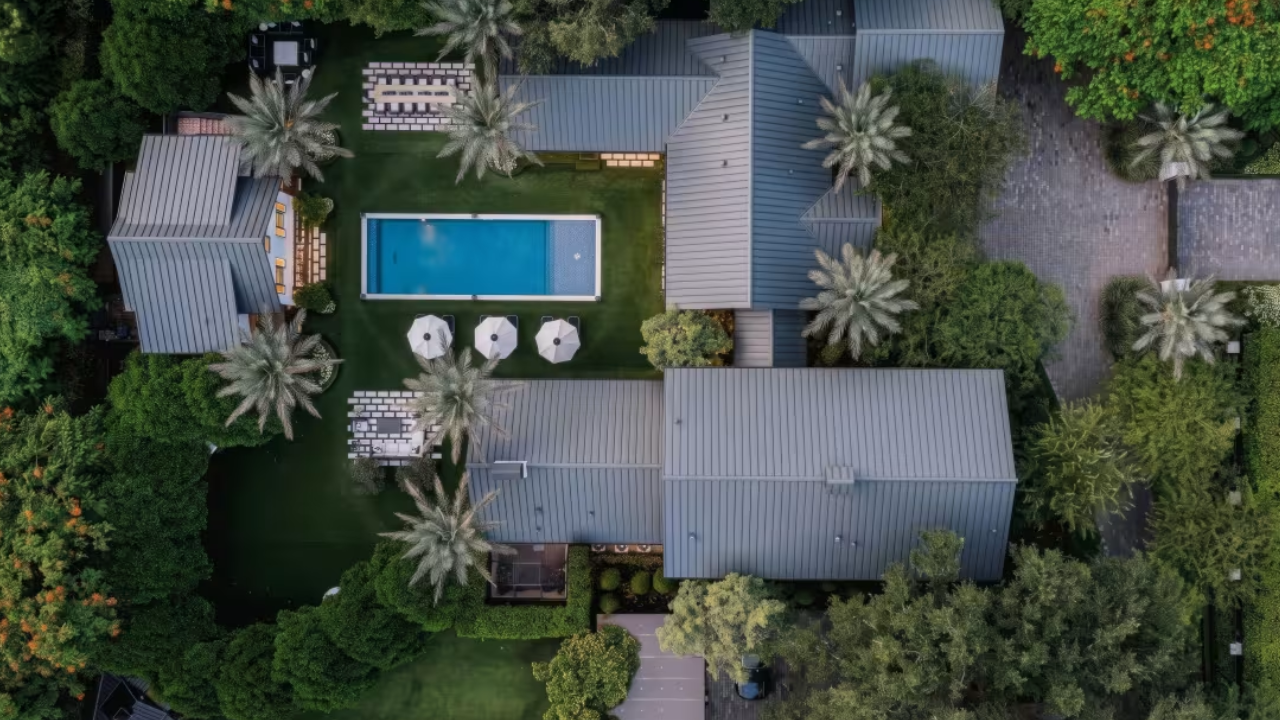
A $13.25 million residential closing in Glenvar Heights has shattered neighborhood records, nearly doubling the property's prior valuation in a single market cycle. This transaction signals a structural shift in South Florida real estate, where extreme land scarcity along the Coral Gables border is forcing ultra-high-net-worth buyers to treat quiet suburban enclaves like trophy waterfront assets.
Most observers look at a price tag like $13.25 million in an unincorporated Miami-Dade census-designated place and assume it is an anomaly. They are wrong. Having tracked South Florida property cycles for three decades, I recognize the exact mechanics at play here. When primary luxury corridors run out of buildable dirt, capital does not leave the market. It spills over the nearest municipal boundary.
The Geography of Spillover Capital
To understand how a single estate commands eight figures in Glenvar Heights, you have to look at a map rather than a spreadsheet. Glenvar Heights sits immediately west and south of Coral Gables and South Miami, bordered by major arteries like Snapper Creek and Sunset Drive. For decades, buyers paid a massive premium just to have a Coral Gables zip code, largely for municipal services, strict architectural review boards, and brand prestige.
That math has changed. Inventory in Coral Gables and Coconut Grove has hit historic lows, and the few remaining teardowns trade at prices that make new construction nearly impossible to pencil out. Buyers arriving from New York, California, and Latin America want modern, gated, resort-style compounds on oversized lots—typically an acre or more—without waiting three years for municipal permitting delays.
Glenvar Heights offers something Coral Gables cannot easily replicate: unincorporated Miami-Dade zoning flexibility combined with massive, mature-tree lots. A buyer can acquire an acre of land, clear an outdated 1970s ranch house, and erect a 10,000-square-foot tropical modern fortress without navigating the notoriously slow historic and aesthetic review committees of neighboring cities. You get the exact same proximity to top private schools like Gulliver Prep and Ransom Everglades, the same 15-minute drive to Miami International Airport, and the same access to Brickell's financial district, all while bypassing municipal red tape.
How a Property Nearly Doubles in One Cycle
Doubling in value is rarely the result of passive market appreciation alone. In the upper tiers of Miami real estate, a 100 percent jump in valuation is almost always engineered through one of two mechanisms—or a combination of both.
The first mechanism is replacement cost inflation. Between 2020 and 2026, the cost of luxury residential construction in South Florida exploded. High-velocity hurricane zone building codes require impact-rated glazing, elevated foundations, poured concrete tie-beams, and commercial-grade mechanical systems. Factor in global supply chain tightening for imported European millwork, Italian stone, and custom smart-home integration, and hard construction costs in Miami routinely exceed $800 to $1,200 per square foot.
Consider a hypothetical example to see how the numbers work. Suppose an investor or developer bought an older estate on a prime Glenvar Heights acre for $6.8 million several years ago. Even if the land value only appreciated moderately, putting $4 million to $5 million of hard construction, architectural design, and carrying costs into a complete gut-renovation or ground-up rebuild automatically pushes the break-even basis past $11 million. At $13.25 million, the seller is capturing a standard 15 to 20 percent development margin on top of inflated replacement costs.
The second mechanism is assemblage and privacy arbitrage. Ultra-wealthy buyers are increasingly paranoid about density. When Miami-Dade County began pushing transit-oriented development and higher-density zoning along the US-1 corridor and near Dadeland, large single-family lots suddenly became an endangered species. A walled, gated acre in Glenvar Heights functions as a private compound. Once a buyer pays a record price to secure that level of isolation, they instantly reset the comparable sales data for every surrounding block.
The Hidden Economics of Unincorporated Miami-Dade
There is a financial nuance that casual market watchers routinely miss when comparing Glenvar Heights to Coral Gables or Pinecrest: the tax and regulatory arbitrage.
Because Glenvar Heights is unincorporated, property owners pay county millage rates rather than layered municipal taxes. On a $13.25 million assessment, avoiding an extra municipal millage layer saves tens of thousands of dollars annually in carrying costs. Over a ten-year hold, that tax differential alone pays for a full-time estate manager or a fleet of luxury vehicles.
The Insurance and Elevation Equation
Elevation is the silent driver of inland Miami real estate. Coastal neighborhoods like Miami Beach, Key Biscayne, and eastern Coconut Grove sit at or near sea level, exposing homeowners to storm surge, king tide flooding, and astronomical windstorm and flood insurance premiums.
Glenvar Heights sits further inland along the Miami Rock Ridge, offering higher natural ground elevation. While windstorm coverage remains expensive across all of South Florida, inland properties on elevated limestone bedrock avoid the worst of the flood zone surcharges. For family offices and wealth managers underwriting a $13 million asset, lower climate risk and predictable insurance underwriting make inland acreage far more attractive than a vulnerable waterfront lot.
Why Traditional Appraisals Fail at the Top of the Market
When a record sale closes in a transitional luxury market, the hardest hurdle is rarely the buyer's willingness to pay. It is the appraisal gap.
Traditional residential appraisers rely on historical comparable sales within a tight geographic radius over the preceding six to twelve months. In a neighborhood where most homes still trade between $1.5 million and $4 million, a $13.25 million contract looks like an outlier on paper. Appraisers are forced to stretch their search radius into Ponce-Davis, High Pines, or South Gables to justify the price per square foot.
This is why record-breaking sales in emerging luxury pockets are overwhelmingly cash transactions—or financed through private bank credit lines collateralized by securities rather than traditional mortgages. When a buyer does not need a conforming bank appraisal to close, price discovery happens in real time based on utility and scarcity rather than backward-looking spreadsheets.
The Ripple Effect on Surrounding Neighborhoods
A single eight-figure closing changes the psychology of an entire zip code. Within days of a record sale hitting the public records, three predictable shifts occur across the local market.
- Land sellers reset expectations: Owners of unrenovated 1960s and 1970s homes on large lots immediately stop pricing their properties based on square footage and start pricing them as buildable acreage.
- Speculative builders move west: Custom homebuilders who have been priced out of Ponce-Davis and Coral Gables begin aggressively door-knocking in Glenvar Heights, looking for tear-down candidates under $4 million where they can replicate the eight-figure model.
- Longtime residents face tax and maintenance pressure: As neighborhood valuations climb, county assessments on newly traded properties reset to market value, driving up neighborhood averages and signaling the end of the quiet, middle-class equestrian and suburban vibe that defined the area for half a century.
The Risks Behind the Headline Number
It would be irresponsible to look at a $13.25 million sale and assume every property in Glenvar Heights is suddenly a goldmine. Luxury real estate at this altitude is notoriously illiquid, and buyers who overpay for the wrong lot face steep downside risks.
Location within the neighborhood matters brutally. A gated acre tucked away on a quiet cul-de-sac near Snapper Creek is an entirely different asset class than a property backing up to commercial noise near Sunset Drive or heavy commuter traffic along Galloway Road. In a bull market, buyers overlook road noise and awkward lot shapes. When interest rates tighten or equity markets pull back, flawed trophy properties sit on the market for years, requiring 20 to 30 percent price cuts to clear.
Furthermore, over-improving for a neighborhood remains one of the oldest traps in real estate. Being the most expensive house on the block by a wide margin means you are dependent on finding another outlier buyer when it comes time to exit. If the broader luxury market cools, capital always retreats back to the most established, blue-chip zip codes first—meaning Coral Gables and Coconut Grove will hold their liquidity longer than unincorporated border neighborhoods.
What This Sale Actually Proves
The $13.25 million Glenvar Heights transaction is not a fluke, nor is it proof that suburban Miami has permanently decoupled from economic reality. It is a textbook demonstration of how wealth migrates when premier markets hit physical and regulatory capacity.
Buyers at the top of the pyramid are no longer buying zip codes for status alone. They are buying square footage of land, privacy, elevation, and speed of execution. As long as South Florida continues to attract corporate relocations and high-net-worth migration while coastal land remains finite, the boundaries of what constitutes a prime luxury neighborhood will keep pushing outward—one record closing at a time.