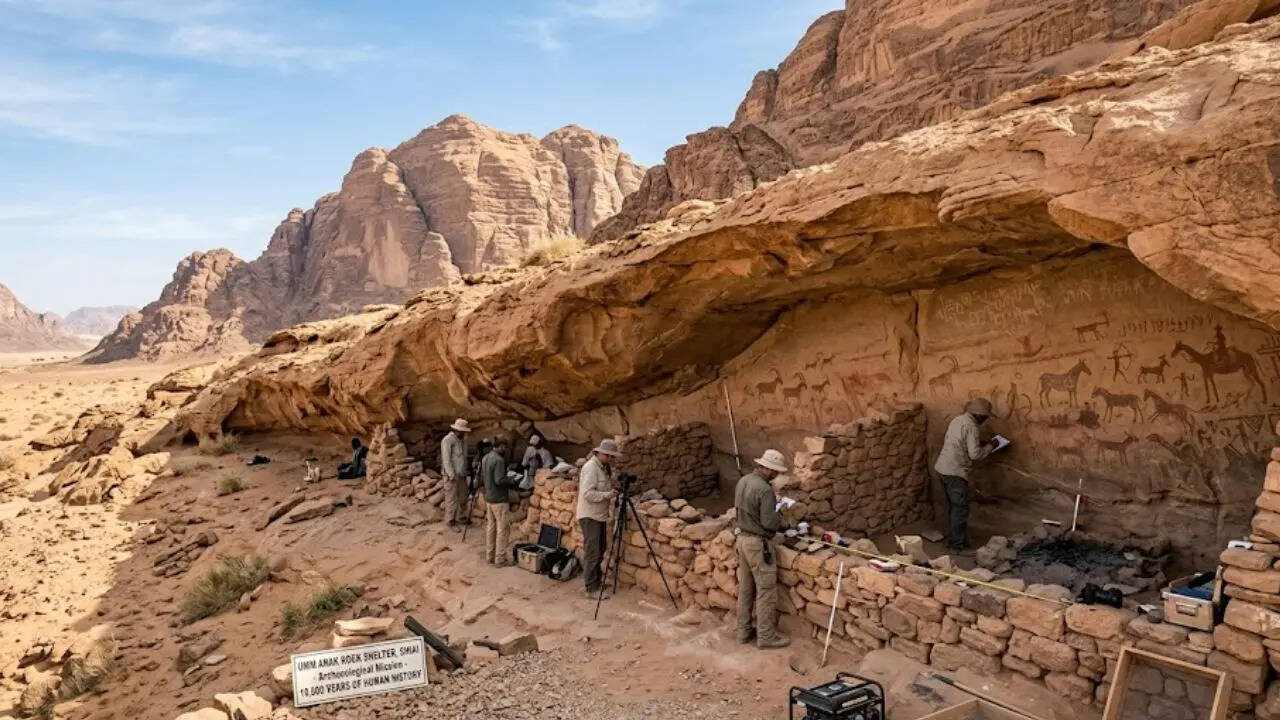
Archaeology has a fetish for permanence. We see a 100-meter slab of sandstone in the Egyptian desert, etched with a few shallow grooves, and we immediately start hallucinating a "lost human timeline." We want it to be a library. We want it to be a testament to a 10,000-year-old civilization that was smarter, deeper, and more "connected" than our own.
It wasn’t.
The obsession with the Kharga Oasis rock and its purported "chronology of humanity" isn't science; it's a projection of our own digital-age anxiety. We are so terrified of our own ephemeral data—our fleeting tweets and decaying hard drives—that we imbue every scratch on a North African cliffside with the weight of a sacred archive.
Stop looking for a "lost timeline." Start looking at the logistical reality of survival in a hyper-arid basin.
The Myth of the Intentional Archive
Mainstream coverage of these rock art sites treats them like a deliberate attempt by ancient peoples to communicate with the future. This is the first and most egregious error.
I’ve spent years tracking site degradation across the Sahara and the Arabian Peninsula. If you want to communicate with someone 5,000 years from now, you don't scratch a giraffe into a friable sandstone face that erodes by millimeters every decade. You build a pyramid. You bury gold.
The carvings on Egypt's massive rock faces weren't meant for us. They were the Neolithic equivalent of a sticky note or a billboard for a demographic that is now extinct. To call it a "10,000-year carved history" suggests a continuity of purpose that simply didn't exist. These sites are palimpsests—accidental overlaps created by disconnected groups who just happened to find shade in the same spot across several millennia.
The Palimpsest Fallacy
When archaeologists look at these 100-meter faces, they often use a technique called relative dating through patination. They look at how dark the "varnish" is inside the grooves.
- Darker grooves = Older.
- Lighter grooves = Newer.
The "lazy consensus" assumes this creates a linear narrative. It doesn't. Micro-climates on a single rock face can cause one section to patinate three times faster than another just two meters away. Wind-blown sand acts like a natural sandpaper, erasing the "oldest" records while leaving younger, more sheltered carvings intact.
What we see isn't a "timeline." It's a survivor’s bias written in stone. We are reading the bits that didn't get sandblasted away and pretending it’s a complete book.
Carbon Dating is the Great Distraction
The public loves a good C-14 date. "Scientists confirm the site is 9,500 years old!"
This is almost always a lie—or at least a massive stretch of the truth. You cannot carbon-date a rock carving. You can only date the organic material (charcoal, ostrich eggshells, or bone fragments) found in the dirt beneath the rock.
I have seen researchers find a hearth from 7,000 BCE, see a carving of a cow five feet above it, and conclude the carving is 9,000 years old. That logic is a disaster. It’s like finding a 1950s Coca-Cola bottle in the dirt next to a 21st-century graffiti tag and claiming the tag was painted by a greaser in a leather jacket.
To get a real date, you need specialized techniques like Optically Stimulated Luminescence (OSL), which measures when sediment was last exposed to sunlight, or cation-ratio dating of the rock varnish itself. Both are notoriously fickle and prone to massive margins of error.
The Neolithic Green Sahara Reality Check
The competitor piece paints a picture of a mysterious, mystical lost civilization. The reality is far more "business-as-usual."
Between 11,000 and 5,000 years ago, the Sahara wasn't a desert. It was a savannah. It had lakes the size of small seas. The "lost human timeline" wasn't a spiritual journey; it was a migration for water.
What the Carvings Actually Are
If you want to understand the 100-meter rock, stop looking for "meaning" and look for "utility."
- Territorial Markers: "This is where our cattle graze. Keep out."
- Hunting Checklists: "We saw oryx here during the last wet season."
- Boredom: The most underrated driver of human history. If you are a pastoralist waiting for your goats to finish drinking at an oasis, you scratch at the wall.
The "mystery" isn't why they carved it. The mystery is why we think it’s a puzzle that needs solving.
The Technology of Destruction
The "10,000-year" narrative is actually dangerous for the sites themselves. By branding these locations as "lost timelines," we trigger a gold rush of "discovery-driven" tourism that does more damage in five years than the wind did in five thousand.
Modern high-resolution photogrammetry—where we take thousands of photos to create a 3D digital twin—is the only way to "save" these sites. But even this creates a false sense of security. A 3D model isn't the site. It's a ghost.
I’ve watched as "well-meaning" researchers apply wet tracing paper to ancient engravings to get a better look. They are literally stripping away the microscopic chemical layers that hold the actual chronological data. We are killing the patient to perform the autopsy.
Stop Asking "How Old?" Ask "Why Here?"
The common question is: "When was this carved?"
The better question: "Why did three different cultures, separated by 4,000 years, choose this specific 100 meters of rock?"
The answer usually isn't mystical. It’s acoustic. Or it’s thermal. Large rock faces in the desert act as heat sinks during the day and radiators at night. They amplify sound, making them perfect for communal gathering. The "timeline" is just a side effect of good real estate.
The Problem with "Civilization"
We use the word "civilization" to describe anyone who stayed in one place long enough to leave a mess. The people of the Kharga Oasis weren't a "civilization" in the way we think of Old Kingdom Egypt. They were mobile, adaptive, and likely laughed at the idea of "owning" a timeline.
By forcing their relics into a linear, 10,000-year narrative, we are colonizing their history with our own obsession with progress. We want to see a climb from "primitive" to "advanced." What the rock actually shows is a cycle of "wet" and "dry," of "survival" and "extinction."
The Brutal Truth About "Discovery"
Every time a headline screams about a "newly discovered" massive rock art site, remember this: the locals always knew it was there.
The "discovery" is usually just a Western academic finally getting a grant to fly a drone over it. This "discovery" culture ignores the continuous human presence in these regions. The "lost" timeline wasn't lost to the people living in the New Valley; it was just invisible to the people writing the textbooks in London and Chicago.
How to Actually Read a Rock
If you find yourself standing in front of a 100-meter wall of history, ignore the placards.
- Look for the overlap. Where a modern Arabic inscription cuts through a Roman-era camel, which cuts through a Neolithic giraffe.
- Notice the erosion. The deepest carvings are often the ones that were most important—not necessarily the oldest.
- Feel the wind. If the wind is hitting your face, that part of the rock is dying.
The 100-meter rock in Egypt isn't a record of how long we've been here. It's a record of how much we've forgotten. It’s a monument to the fact that humans will do anything to leave a mark, even when they know the sand is coming to bury it.
Stop looking for a "lost" history. It isn't lost. It’s right there, being sanded down into nothingness by the same desert that gave it a voice.
Accept the transience. The rock doesn't owe you a timeline. It doesn't owe you a story. It’s just a stone that outlasted the people who touched it. And soon enough, it will be gone too.